
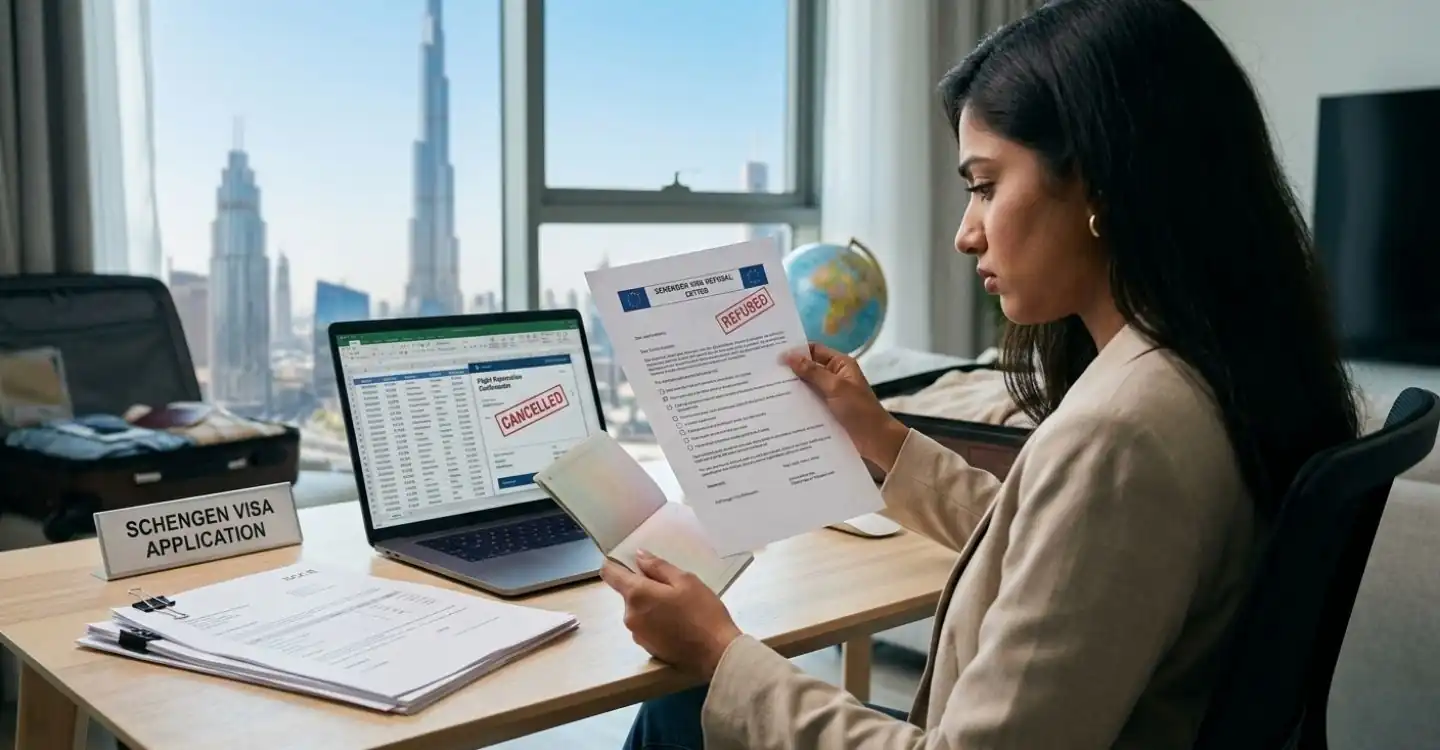

Schengen visa rejection in the UAE is a deeply disappointing and frustrating experience, but if you have recently faced a refusal, you are certainly not alone. Navigating the stringent European immigration frameworks from Dubai or Abu Dhabi has become increasingly challenging, with latest data revealing that the UAE Schengen visa rejection rate has climbed to a staggering 22.44% in 2026.
While receiving that official refusal letter can feel like a definitive end to your travel plans, it is critical to understand that a rejection is not a permanent ban. It is simply a diagnostic checklist indicating specific flaws in your application file that can be legally appealed or corrected through a structured reapplication. To successfully overturn this decision, you must first decipher exactly why the consulate flagged your profile, shifting your approach from stressful guesswork to strategic action.
A Schengen visa rejection is arguably the most frustrating disappointment to a group of residents from the UAE who are enthusiastically planning to visit Europe. For many applicants, dozens of hours go into collecting documents, booking flights, reserving hotels and planning itineraries – only for them to be handed a short, cryptic and confusing withdrawal letter.
In 2026, matters have become even more complicated. The UAE Schengen visa rejection rate currently stands at about 22.44%, and this far exceeds the worldwide average rejection rate. The statistics tell us that this is more than luck; yes, it is more stringent immigration checks on arrival, more advanced systems to check for proof of affluence and more stringent software with obvious descriptions of how the applications are being judged and algorithms for detecting potential fraud.
But there is one legal truth you should know.
A Schengen visa refusal does not mean a ban or blacklist or record of failure for all time. It is but a procedure that can be appealed, rectified, or successfully overcome.
There are tens of thousands of applications in the UAE alone that are refused each year due to simple and avoidable mistakes such as lack of financial evidence, a broken travel plan, or unsettled employment ties. The best news is that each of these issues is fixable.
This guide will help you understand:
Analyzing rejection rates guides applicants in setting aspirations accordingly and noting common trends of risk.
Global Schengen Visa Rejection Rate
Average Rejection Rate Worldwide 2026 Averaged across all nationalities, the global rejection figure is 14.8%. 1 person out of every 7 is turned down. Nevertheless, this figure may fluctuate widely from country to country.
Reasons for the Higher Rejection Rate for UAE Residents
Applicants in the UAE have the following unique issues to contend with:
Thus, they hold UAE-based applications for much more careful examination, especially for first-timers.
| Category | Country | Approval Rate | Risk Level |
| Low Risk | Iceland | ~91.25% | Very High Approval |
| Low Risk | Slovakia | ~89.25% | Stable |
| Low Risk | Italy | ~88.72% | Balanced |
| Medium Risk | Netherlands | ~80% | Moderate |
| High Risk | France | Lower approval | Strict Screening |
| High Risk | Germany | Lower approval | Financial strictness |
| High Risk | Spain | Lower approval | Itinerary verification |
Not all embassies evaluate applications equally. Some countries have stricter interpretations of:
This is why choosing the correct embassy is a strategic decision—not just a travel preference.
Understanding rejection reasons is the foundation of a successful reapplication or appeal.
Financial stability is one of the most heavily scrutinized factors in Schengen applications.
Embassies do NOT only check your balance. They analyze:
Consulates view unexplained deposits as financial manipulation, which raises doubts about genuine travel capability.
For UAE applicants:
“Motive 8” is one of the most serious and misunderstood rejection codes.
It indicates:
“The applicant Has not shown evidence that they have strong connections to the country of residence or origin.”
Schengen authorities are not only assessing travel intent—they are assessing return intent.
Embassies carefully compare:
A realistic, structured plan:
Travel insurance is compulsory—not optional.
Many applicants purchase low-cost UAE insurance policies that:
This alone can cause rejection.
This one causes refusals on the highest level.
All Schengen applications are stored in the VIS (Visa Information System). Any fraudulent submission can affect future applications across multiple countries.
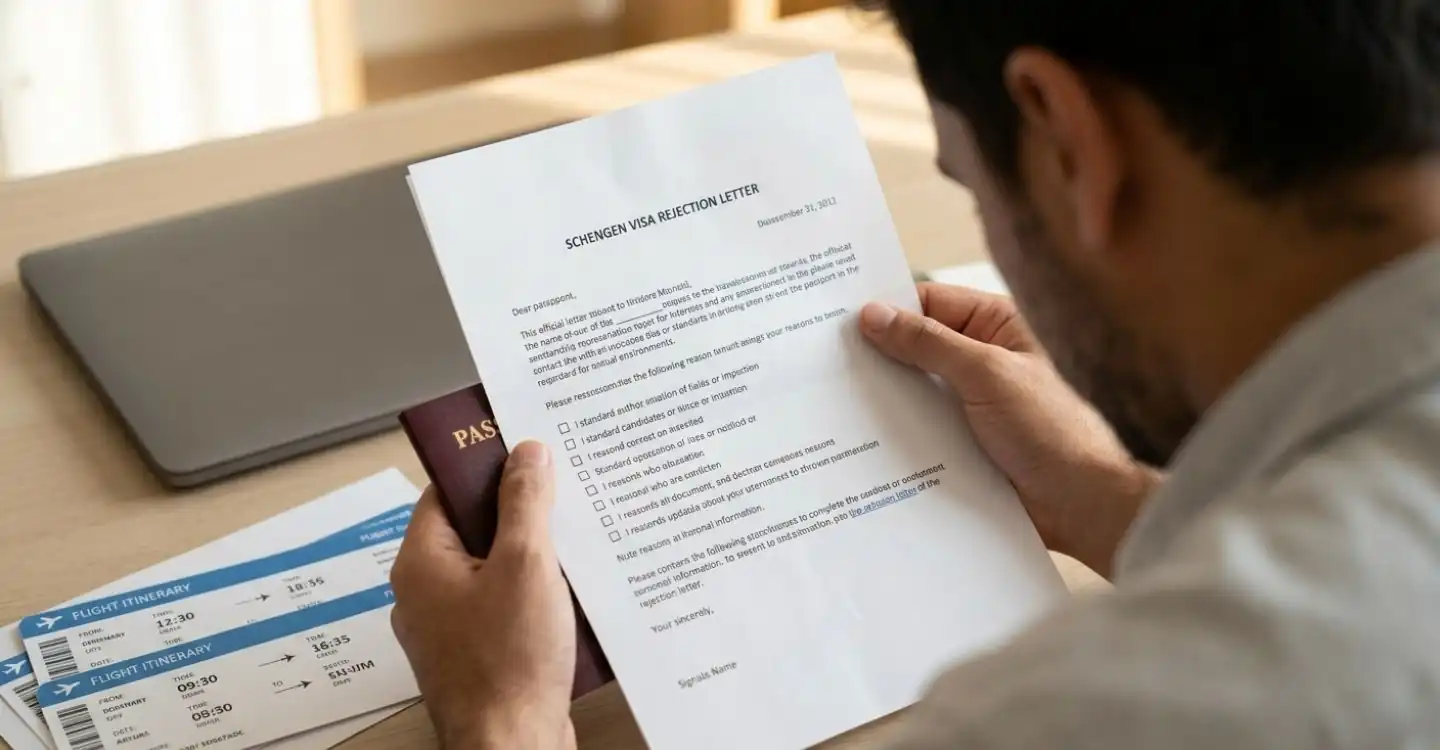
Your Schengen visa rejection letter is not just a refusal—it is a diagnostic document.
Most rejection letters include:
Each checkbox corresponds to specific refusal categories:
In 2026:
This means:
Even without a visible stamp, your refusal history is permanently stored.
Common signs include:
This is the most important decision after rejection.
Choose a Schengen visa rejection appeal if:
Reapply if:
If you are rejected multiple times:
Appeals follow strict legal procedures.
| Country | System |
| Germany | Remonstration (embassy review) |
| France | CRRV commission (Nantes) |
| Spain | Administrative court appeal |
| Italy | Prefettura appeal process |
Success depends on:
A well-supported appeal letter generally has a higher success rate.
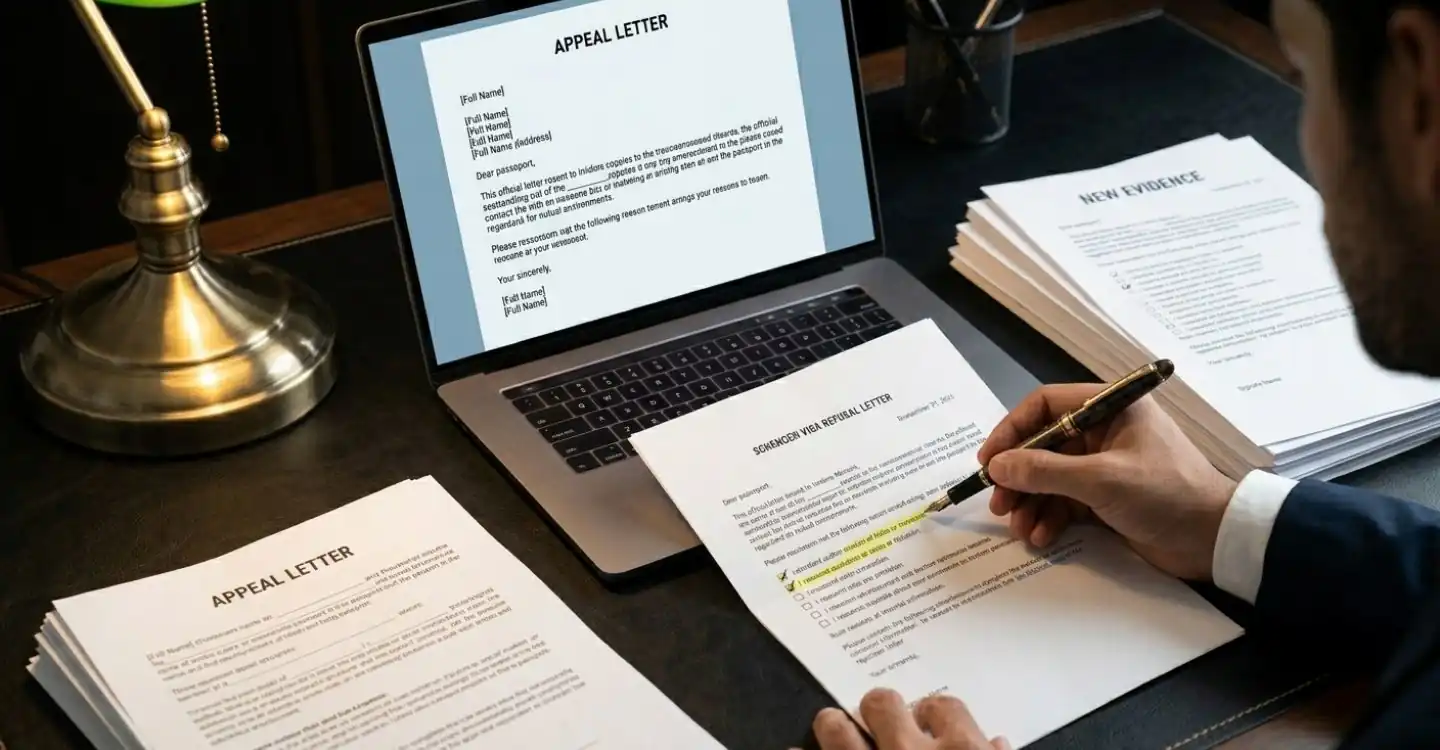
A strong appeal letter for Schengen visa refusal must be:
[Full Name]
[Passport Number]
[UAE Address]
[Email]
[Date]
To: Embassy of [Country]
Subject: Appeal Against Schengen Visa Refusal Decision
Dear Sir/Madam,
I respectfully submit this appeal regarding the refusal of my visa application dated [date], reference number [number].
The refusal under reason [X] appears to be based on [brief explanation].
I would like to clarify and provide supporting documentation as follows:
All required documents are attached for reconsideration.
Kindly review my application again.
Sincerely,
[Name]
Yes—immediately after refusal.
There is no mandatory waiting period.
Reapplying without fixing issues = guaranteed refusal.
A rejected application requires strategy, not repetition.
Refusal letter decoding
Bank statement restructuring analysis
Employer NOC drafting
Travel itinerary correction
Appointment prioritization
Let experts handle your case with precision.
Chat with Odit Travel on WhatsApp
Submit your visa recovery case online today
Don’t risk a permanent VIS black mark. Let our experts analyze your refusal letter today. [Chat with Odit Travel on WhatsApp] or fill out our online visa recovery form for an immediate consultation!
A Schengen visa rejection in the UAE can be a heart-breaking experience, particularly for all the time, effort and funds you would have already engaged in planning your stay. While being refused a visa can be a little difficult to come to terms with, it is essential to realize that a refusal is merely an indication of how your document package was viewed by the deciding officer, not an indication of personal merit or worth.
Schengen visa rejections are usually quite simple to rectify, as they are commonly caused by errors and elements within your application that can be easily put right – these include an inability to produce clear accounts, inadequate proof of employment, a poor track record of previous travels, incompatible supporting documentation or inadequate travel plans.
Instead of reacting emotionally and immediately lodging a fresh application, what needs to be done is as follows:
Schengen embassies adhere to very strict compliance and risk-assessment procedures, and they are not indeed expecting perfection from travellers, but they do require all documents filed to be consistent, clear, convincing and credible. That makes a huge difference.
Getting more refusal can often result in submitting further applications in the hope that changes to the application content will secure a successful outcome. Unfortunately, more of the same often results in the same – more refusals. This is why identifying the core concern is fundamental to a successful Schengen visa application process:
A successful Schengen visa application from Dubai or the UAE must have:
At this stage, knowing the right people to speak to can be invaluable in order to succeed in the Schengen application process.
For those who want professional help, there are reputable companies such as Odit International Travel & Tourism, who can help with documents, review your application and recommend travelling plans, etc., helping you have a greater chance of your application being successful.
The key to a successful outcome is allowing you to reapply with an improved application file. A visa refusal is not necessarily the end – it is an opportunity to submit an improved, credible and accurate application again.
With the right business plan, the right documentation, and guidance and advice, you can improve the probability for your next application enormously.
No, Schengen visa fees are non-refundable. The relevant consulate or embassy required a payment of the visa fee for processing your application. This payment will be made whether your visa has been granted or refused. Even if your Schengen visa has been refused, the visa fee payment will not be reimbursed to you.
Previous refusal of a Schengen visa is not likely to cause a US or UK refusal; however, the department of immigration may take into account any past refusals when reviewing your application.
The Schengen visa appeal process is quite lengthy and may take 1-6 months depending upon the respective embassy / country. The processing time also depends upon the nature of case, documents submitted, appeal procedures of the Schengen state, etc.
Unsatisfactory proof of funds, ill-defined travel plans, incomplete documentation, lack of ties to the UAE, travel insurance validity, inconsistent information submitted to the embassy, etc., can be common reasons for a Schengen visa rejection for UAE residents.
The Schengen visa rejection rate for Indians and Pakistanis in the UAE is almost 10 to 25% depending on the country you applied to. Showing good documentation and financial backup can in fact help to avoid Schengen visa rejection.
There is no hard and fast rule, and applicants should aim to keep a minimum of AED 8000 to 15000 for short trips. The money should be in the account to reflect a steady flow of income, cover the trip expenses and suit the itinerary to avoid Schengen visa rejection.
Yes, you can reapply immediately following any Schengen visa rejection. Though you should take into consideration the reasons for the refusal and ensure you rectify errors/issues with your documentation prior to re-application, as your chances of success will greatly increase.
No, the UK and US visa choices are independent; however, a previous Schengen visa refusal may influence your future immigration clearances if not dealt with.
No, there isn’t. Both the charge for using the services of VFS and the fee demanded by the embassy are non-refundable. Since these fees solely account for administrative and processing purposes, you won’t be entitled to any refund if your application for a Schengen visa gets turned down.
Yes, appealing a visa refusal from the UAE to Schengen is possible by filing an appeal letter, along with relevant proofs, at the individual embassy dealing with your case. The time span for an appeal generally is one to six months but may vary based on the specific embassy, case and country’s rule.
WhatsApp us